The stories we tell ourselves…

It’s a mere fragment of a story, but it sticks with me as it’s the first time I truly realised how easy it is to add imagined facts to stories. Mark and I were living in the Mongolian countryside at the time and were away. Our neighbours, who hadn’t spoken with us, were telling our friends that we had gone to England. A few days later, when we returned, everyone was surprised.

A silly incident perhaps, but it serves as a reminder to me of how easy it is to jump to a conclusion when I see something happen or, having a single piece of information, let a story unfold in my head. Why do I do this? Perhaps I am trying to satiate curiosity by removing uncomfortable ambiguities that leave unanswered questions hanging.

A couple of weeks ago, someone told us that some Mongolian friends were leaving Central Asia to resettle in Korea. We were shocked! How could this be? God had done amazing things to get this family to the mission field. Surely, they couldn’t be leaving now. As I thought about it, my mind raced ahead, reasoning out their decision and filling in the blanks.

Half-way down the road of rationalising this piece of news, I decided to call the wife and ask her directly. A few minutes into the conversation everything became clear. Her husband had gone to Seoul for medical treatment, she and her daughter had planned to accompany him but weren’t able to. They had asked people to pray and so the story had evolved.

It is typical in cross-cultural relationships for me to make up parts I don’t know based on what I think I understand. I note the term ‘cross-cultural’ can loosely extend to most relationships, for I am a countryside girl married to someone from London and we’re still working on understanding each other.

Telling stories is a natural part of who we are, perhaps even the adding of bits we don’t know is too. But I can’t help thinking that the stories I make up about myself can be the most harmful. In my mind they often become a confabulation of something factual combined with anxiety. And anxiety seems to rush at breakneck speed to feed my insecurities.

‘Stop,’ I shout, the moment I realise my thoughts have become derailed. It’s time to regain perspective, God’s perspective, and to let peace and clarity return. ‘What do I need to learn here?’

Quietly, the answers come. Embrace the unknown. Learn to be content with ambiguities and unanswered questions. It is after all what faith is all about; choosing to trust rather than fear. Trust, with an open heart, the One who knows the beginning from the end, even when I do not know the very next step of my story.

To embrace the unknown means unclenching my fist and fully releasing control of the narrative of my life to another. It means living and loving with courage and authenticity, letting God surprise me and others teach me His way, as relationships grow and mature, through the bad times and the good.

Embracing the unknown is not always easy. But I am learning, trusting that God knows what is best for me and that, in His great love, He continues to redeem and rewrite the unhealthy narrative that plays in my mind, for my good and for His best true story.

© copyright Gillian Newham 2023

Messy and yet…

Discussing Abraham’s many struggles and mistakes, we were thankful that God saw his heart and considered him a friend. A member of our group added, ‘God saw Abraham’s potential and knew who he would become.’ These words connected with my heart as this is exactly how we want to see our friends here. We want them to grow in godliness and the giftings that God has given them, though it is not always easy. We have made some spectacular mistakes along the way, but we’ve also seen God do beautiful things too.

              I note that a fair amount of turmoil and heartache seems to accompany the change and growth that needs to take place in my life. God calls us to love Him and to love one another. The loving Him part sounds the easier, until I realise the catch that loving Him requires me to truly love others too. Doesn’t God know how messy and costly it is to build relationships with people who have issues? They are angry and bitter, jealous and avaricious… the list goes on. ‘Too hard,’ I shout, entertaining thoughts of dashing away to some holy corner.

              A moment of quiet and honest prayer shocks me, as I hear God’s clear answer, ‘You only see in others what is in you!’ That’s a chilling revelation, like discovering a plank in my eye.

              These friendships are not a way one street. He has plenty to teach me here too. Loving those who struggle confronts me with my helplessness. I cannot fix them. I cannot fix myself. Yet, in loving God, a love flows from me that I cannot contain.

              With the eye of faith, freed from splinters, I learn to look beyond the masks and tactics, trusting God to enable me to see people as He does. I do not disregard the wrong. Neither do I imagine that my faith in a person will cause them to make right choices. Instead my acceptance, like an invitation, hopefully provides an opportunity for them to move towards God and allow Him to bring change.

God surprises me, meeting people in the most unimagined and incredible ways and gifting them with the priceless gifts of forgiveness, a clear path and a new life. This gospel message is full of mercy, giving us what we do not deserve. It brings me face to face with Jesus’ incredible kindness.

God created us for relationships. Jumbled and painful, exuberant and soul quenching, they fill our lives, spanning every emotion we can ever experience. God longs that our relationship with Him and others are holy and healthy, and for that we need His help.

Thankfully, He knows this better than we do. He spoke and His word became a man and lived amongst us; Jesus the expression of His love, entered our tangled humanity to rescue us. He did not wait for us to be ready, but welcomed us, bringing hope to the world, enabling us to be continuously changed into the people who love. No wonder the true message of Christmas is so profound, it has the potential to bring a lifetime of change to derelict lives.

© copyright Gillian Newham 2023

Baasan-huu. . .

‘We all live busy lives,’ said Baatar as he preached on Sunday. We agreed, thinking of time spent sitting on Ulaanbaatar’s vehicle-choked roads, trying to find a precious parking space before the two of us head off in different directions to days filled with meetings, tricky discussions and lessons. We love what we do, but by the time we’ve crammed as much as we can into one day, we feel frazzled.

              It’s not the first time we noted the swift pace at which city life moves and pondered Baatar’s question, ‘How do we find balance and peace in God in the midst of the rush?’

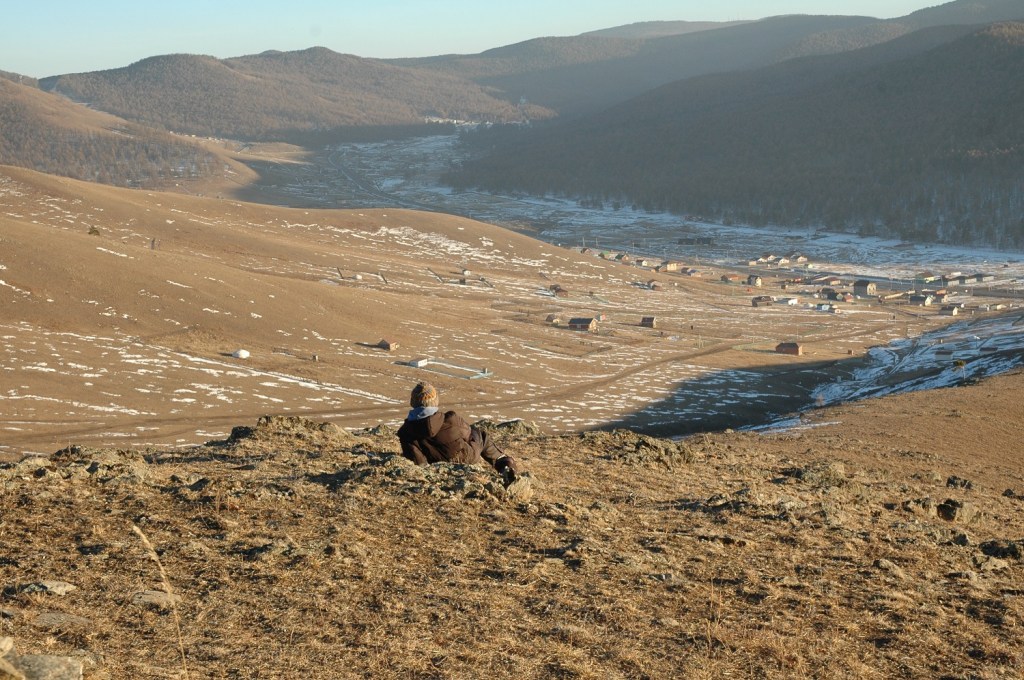
Last Saturday we drove over the pass to walk some of our favourite ridges. The valley used to be home to a few herders and their animals; now new fences cover the hillsides as people claim the best spot for their summer holiday homes. Thankfully, the herders are still there and there’s one we’ve got to know.

Originally from the city, Baasan-huu lives in a ger with his wife and family at the bottom of the hill close to the road. First time we chatted with him, he was lying leisurely beside his horse, reins secured around his boot, so his horse could not wander off. Handing us his ancient Nokia phone, he asked us to help him use it. Not that he needed the phone as his loud instructions to his granddaughter echoed through the whole valley.

On Saturday we talked with Baasan-huu about war, life, church and politics. In his long red deel and thick felt boots, he is a quiet, knowledgeable man. Through his large round glasses, perched on the end of his nose, he eyes us sagely.

              We said our goodbyes, observing him too as he picked up the reins to lead his horse and flock over the hill and up the next valley. The sun dropped, silhouetting man and horse against the pale sky as they climbed the rocky slope. There was an ease in his gait, a nimble steadiness that denies his seventy or more years. He is at home in this place, he knows it well.

              Part of me envies the simplicity of his life, firmly embedded in family and locale. The land is important to Mongolians, especially countryside folk, who feel like they are a part of it. I have no such connection, although I do know the one who created this place. It is His and reflects His nature.

              Baasan-huu’s life is one of stable discipline: work, food and rest. Not that he lacks challenges, but the unhurried nature of it resonates with rhythm. This rhythm causes me to recall the rhythms of godliness I seek to cultivate in my life: prayer, deeper understanding of God and His word, ministry and rest.

              Like Baasan-huu, I must discipline my life. To find balance amid life’s constant activities, I habitually need to learn to quiet my heart and mind and be open to God’s grace. Embracing and receiving His grace brings stability to my scattered, tired thoughts. This stability roots me in God, enables me to navigate the ever-changing flow and recognise that God is in the city rush and the hushed wooded forest too. He is everywhere.

© copyright Gillian Newham 2022

Still Learning. . .

‘Self-forgetting humility,’ a phrase that C.S. Lewis used in Mere Christianity, bother me. It has got under my skin, niggling away at me when my focus shifts to ‘self’, which sadly seems quite often.

Recently Mark and I were guests at a conference. As this was the first conference since the lifting of all covid restrictions there was a desire to make this a special time for everyone. Great care had gone into the planning, schedule and choice of venue so that all could enjoy.

However, just prior to the conference, the leaders learned that the Retreat centre’s heating system had broken down and was not easily repairable. In a moment, all those careful plans disintegrated. Hastily, the leaders put a new schedule together and the weekend went ahead, although one of the planning team was distraught. Having worked diligently to have everything in place to make the weekend a success, he felt like he had failed. The weight on his shoulders was crushing.

Watching his distress, although not fully aware of his feelings, my own heart’s frailties flooded into my mind. How many times have I been equally crushed, when ‘self’ confidently believes the illusion that I could successfully organise life, even my own life. Inadequacy fills me, leaving me hurt and hollow on the inside, comparing my shortcomings and failures with the perceived successes of others. My tangled mind believes the only answer is to do more, to try harder. But I am always disappointed and have never once lived up to my own, or other people’s, standards.

How do I grow beyond this? What do I have to do, especially when I live in a culture that applauds efforts to be good, yet I cannot make myself worthy. My efforts are futile. Placing my confidence in ‘self’ is as foolish as hoping in the sturdiness of a balloon. Sooner or later, it will burst.

Finally, I speak to myself, ‘Forget trying to nurture ‘self’, with its pernicious focus. Redirect your eyes to the One who loves you and accepts you totally, in whom there is no condemnation.’

The truth focuses me. Another took the judgement I deserve and the verdict has already been announced. The One whose opinion truly matters counts me precious. I have no need to justify myself, or even to try feeling better about myself. I must simply let myself become preoccupied with another – Jesus.

But I am still learning. This is a different mindset; no, a different identity! Work and ministry are no longer about me. Whether at home or church, in the city or the countryside, I must relive the truth of the gospel, reminding myself of what He has done for me, for us. Perhaps this is the essence of self-forgetting humility: in looking to Him and those around me, ‘self’ begins to fade and I slowly learn to appreciate who He is and what He is doing in this world.

© copyright Gillian Newham 2022

Belonging. . .

To live in a place is a beginning. To belong to that place is something more. Mongolians who live their lives in the countryside, whether it be on the steppe, hills or in the desert, intuitively carry with them that sense of belonging. Spoken or unspoken, they know what it to have a connection with the land, to be a part of a place and its people.

              But this connection is no romantic notion or superficial feeling. Rather it’s rock solid, founded on reality. Many have learned to submit themselves to the place and its people, to work with the resources at hand which, in turn, fit them to flourish. Of course, some come with bright ideas and end up committing acts that harm the land, its community and ultimately themselves.

              I remember a time when we had lots of new ideas. Newly arrived in Mongolia, we came armoured with grand, idealised schemes which, fuelled by youthful enthusiasm, naturally turned into action. Graciously, the Mongolians tried to follow what we instigated, but as time moved on their interest and commitment waned. Initially we were frustrated, until the light dawned and we understood: the problem wasn’t with them but with us. What we were trying to implement, no matter how good it seemed, chafed with the Mongolians because it didn’t fit with the people they were.

              But God was gracious and gave us a deepening love for these people which halted our efforts causing us to ask questions. The questions enabled us to pay attention to this place and, more importantly, the details of people’s lives, their culture and circumstances. Understanding grew and with it the realisation that we must abandon our own notions, submit ourselves to God’s call and learn the realities of His ways. As our understanding of Him grew deeper, through His word and by listening and engaging in conversation, so relationships grew.

Our vision began to change and become full of possibilities that fitted this place and its people. But still, this place had more to teach us.

The Mongolian herder’s life has rhythm. Following the seasons, his days are measured and largely unhurried, and yet each year all which is essential to life is accomplished. It took us time to slow down and grasp the subtle lesson that more activity is not necessarily better, it is simply more. Even though society tries to distract us with busyness and presses for speedy results, life does have limits and we need to pay heed to those limits.

God is not in a hurry. Instead, He takes a lifetime and more to work out His purposes. Patiently, and in a detail, specific to each of us, He nurtures His people, working redeem into our eroded lives. He encourages us to acquire disciplines that cultivate habits of forgiveness, reconciliation and love where once mistrust and fear dwelt.

He is fitting us for His purposes, establishing our place of belonging in Him.

© copyright Gillian Newham 2022

Take That Step. . .

Conversations, always there are conversations. We meet pastors and local leaders, missionaries and those who are searching for truth. Often, it’s only after, when we have time to reflect on discussions, that we pick up on the significance of some comments.

              Last week we met with a couple who led a city church, have been involved in mission overseas and now are working in the countryside. We were talking about growth in godliness and character when our friend said, ‘That’s all very well, but what we have here now is how it is and we can’t change it.’

              We nodded and the conversation continued but when we got home, we wondered: do such comments surreptitiously imply that we don’t believe God can or wants to change people? It used to be that the young Mongolian church would entreat God to act in miraculous ways, to change lives and to heal, however, sadly, today some churches seem to have found a comfortable spot where they settle for less.

              Naturally, life’s rough treatment batters our early experiences of the simplicity of faith. Worries and problems drain us. Different opinions and personalities bring discord, and man’s worldly wisdom questions our belief in the ultimacy of God’s power. Our faith is under attack and, without care, we can be misled.

              Yet, if our focus is on God alone, we see the underlying truth: fear dominates many lives. Crisis comes, people cry out, praying to a being, a god they do not know but sense exists. They need Him, need His help. Bargaining, they promise allegiance to Him. Only, when the trouble has passed the promise soon fades.

              There it is again – that question: Can God really change man? Experiences of the world’s reality seep into my mind overshadowing God’s truth and leaving me hesitant. I want to take a step of faith and believe, but my confidence is weak. Nevertheless, I determine to step over my doubts, surrender my frustrations, disappointments and fears and accept God’s mission. I will not hide my faith, will not keep it a private affair. I will bring it out into the open and declare the realities I know: God saves, He changes lives and births us into a kingdom that will last forever.

              These steps that take me beyond momentary uncertainties fill me with quiet strength and assurance. The world is searching for true meaning, for the real God. Maybe it’s unrecognised, even unarticulated, but the longing is there. When we walk through this world, living out the realities of our faith in God and being, by His grace, the person He designs us to be, then He works. His care and compassion impacts those around us, giving Him opportunities to bring change. We do not know how or what He will do in and through us, but one thing is certain, He will bring change to my open heart and others too because His heart is to redeem and continue redeeming man.

© copyright Gillian Newham 2022

Adjusting to God’s Pace…

The rows of orderly traffic surprised me; each car in its lane, no one jumping the lights and hardly anyone honking their horns. We had just stepped off the plane from Ulaanbaatar and were waiting to cross the road. The cars in America readily stopped for pedestrians and, unlike many Mongolian cars, most appeared to be in pristine condition with few scraps and dents.

‘Metallic horses.’ That’s a phrase many Mongolians use when talking about their cars. The phrase always makes me smile because it conjures a picture of cars weaving in and out of city traffic at breakneck speed. Not only that, but it also reminds me of the daring ways in which many Mongolian drivers venture up trackless hillsides and cross flowing rivers. Admittedly, there are those who are sedate and treat their vehicles with more care.

Although battered and chronically ailing vehicles continue to fill the streets, spewing out noxious fumes as they go, it is easy to fill a car with what it needs and expect it to keep going no matter what. However, maintaining a vehicle in Ulaanbaatar so that it runs at its optimum takes a little more thought.

Ulaanbaatar is a small city that has grown rapidly. It is a busy, restless place, impatient and, at times, overloaded. A place that draws me in and quickens my pace until I’m caught in its go, go, go. I am slow to recognise the change in me or realise that I’m trying to push myself too hard up that impossible hill. Only when joy and fulfilment dissipate and God seems strangely distant, do I listen to the dissonance in my heart. It grates against my attempts to convince myself that a life of busy, engaged ministry equals a healthy spiritual life.

I wonder, how can I quickly complete all that lies before me? I falter and flounder. God feels even further away. I keep on going, not knowing what to do; reacting to symptoms rather than seeking to understand and respond to the root causes of problems.

And then, in the frenzied rush, comes a tap on my shoulder, a soft voice in my ear. ‘Who is the infinite one, the Creator, the one who never sleeps and is present everywhere?’. I still myself, cease trying to fix others or foist my plans upon them and answer: ‘Only You can be all things to all people.’ I am not God; I am a human being. It is obvious, but in the franticness of activity and in the face of great need, I lose sight of that. I’ve stretched too far, pushed beyond the limits that God has created for me. I orientate my heart back to Him, asking Him to lead me in His way.

Resting, I return to myself in His presence; the reality of who I am, rather than who I want to be. I decide to live within the limits of my capacities. I will choose to deepen my walk with God. Quietness and resolve renew my energy. God keeps me steady and alert, caring for me in all that is good and right.

Ulaanbaatar drivers still push their metallic horses fast and furiously. The city still moves at pace, but I’m happy to let it all pass me by because I’m learning to walk differently, within boundaries to a pace and rhythm fitted to who I am, sustained and fulfilled by God. This walking pace is His very best for me.

© copyright Gillian Newham 2022

Thinking about legacy…

‘What do you want to leave behind?’ a friend asked right in the middle of a busy period of conferences, forums and discussions. Although she could have been referring to anything, we knew what she was referring to. It’s a question that we considered many times, but just at that moment we didn’t have time to answer. We were moving at pace, admittedly no longer at the forefront but standing behind, watching as our Mongolian friends fulfilled their vocation. It was and is exciting and deeply satisfying to see them lead with confidence and maturing ability.

              Stepping back for a moment and thinking about what we’d like to leave behind, or perhaps what we’d like our legacy to be, takes us back to basics. While it is encouraging to see Christians engaged in fruitful ministry, our primary prayer is that Christians here might have an ongoing desire for intimacy with God. Not that we are planning on leaving tomorrow, I hasten to add.

Our prayer might sound super spiritual or perhaps over-simplistic but personal experience tells me it’s easier to be busy doing things than to be still before God, easier to trust in my own wisdom, resources and strength than to let go and trust in another. And even easier to crowd my life with service that doesn’t flow from the heart of my relationship with God.

To stop and humbly let go of my preconception that says, ‘I know’ and admit that I don’t know, takes courage. It is a struggle, a wrestling back and forth with God and self until my illusions are exposed, along with the dangers and abjectness of my heart. I call on Him in times of trouble and need but when all is well my voice can become tinged with pride. God must reawaken me to Himself, so that my focus is Him, not self, not busyness, just Him.

To do this, I must make space, beyond the noisy activity, to create a quiet heart that grows in trusting God. A heart that observes what, in the rush of activity, I tend to dash passed: the extraordinary amid the ordinary. A heart that catches glimpses of God’s perspectives, His love for people and His compassion that seeks to redeem us so that He might have a relationship with us.

Too many times I focus on the results of my efforts rather than taking time to understand God more fully and submit to Him. I marvel at what He has done for me and for us. I am awed by what He calls me to do: to anchor my life in Him, abide in Him and His word, and let His truth penetrate the illusions that fill my life.

But I cannot do it alone. My self-improvement efforts are disastrous. Only by the power of the Holy Spirit, through submission to God and prayerful dependence on Him, can He accomplish such Christ-like growth in me. It takes constant humility to come close and ask, and yet it deepens my love for God and compassion for others which in turn energises my mission. Ministry, or service, (as the Mongolians say,) for God is born out of our love for Him not out of obligation or indebtedness. And love that longs for a life-long deepening intimacy with Him, is the heartbeat of our mission and service.

© copyright Gillian Newham 2022

He is here. . .

I feel like I live in two places. One, I spend my days in city of Ulaanbaatar walking with friends, listening to their stories and seeking to recognise God at in work their lives. I love it, but there are moments when the city-life consumes my attention, running like an unending montage of scenes before my eyes. The rush of people, the throb of traffic-jammed streets and burgeoning high rises that bind the city, enclosing the skyscape, make it hard to still my mind and discern God’s workings.

              The other place I live, our home, is on the edge of the city in a rural district. There’s a small river close by, where we often walk. It is neither wide nor deep but the water is clear and glows silver under the sun’s sharp rays. The river flows into the city where sadly, it will become a turbid brown soup filled with rubbish.

              Two crows follow the water, flying parallel like a pair of skaters, until one nips the other. We watch the wind rise. Yowling, its voice grows louder and higher. It turns and twists, gathering sand in its grasp and flinging it on all in its path.

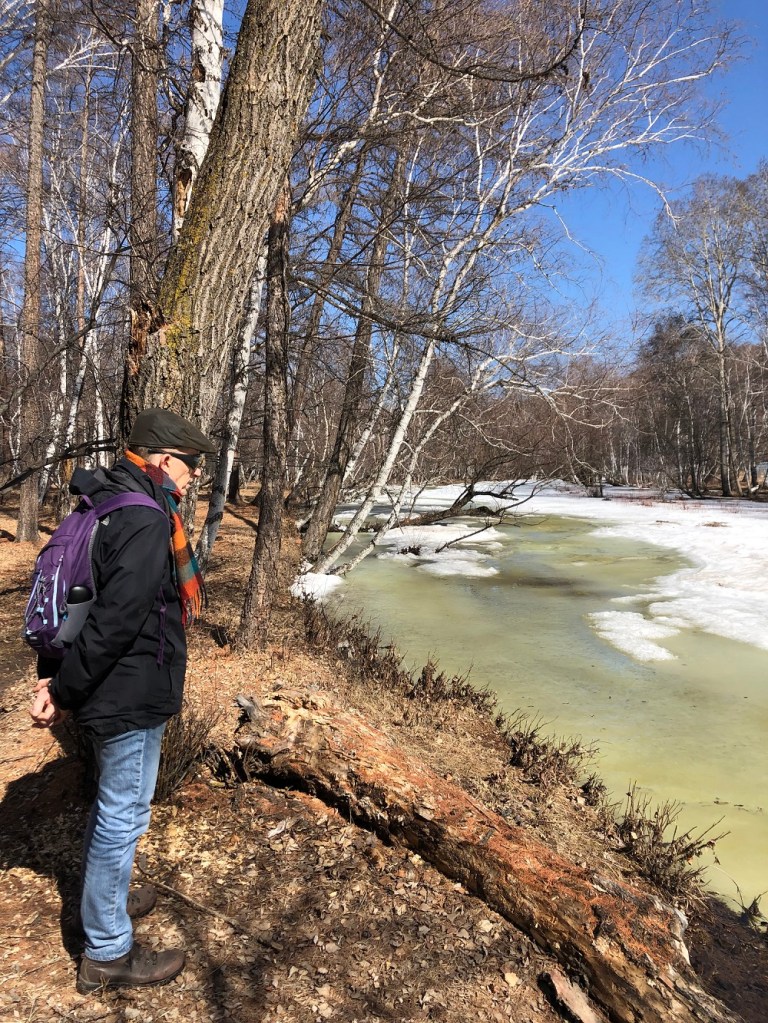
We retreat to the forest, walk amongst giant anthills, observe the pines and silver birch standing side by side. Our feet crunch on a floor littered with cones and needles. The warmth of the sun releases the fragrance of the earth. Green shoots push through the dryness and a tiny head furtively appears in the mouth of a hole. His nose twitches as he checks whether it’s safe to venture out after a long hibernation. The forest is reawakening.

We walk this place. Trying to understand it, we observe movement and growth, the path of the wind and the feel of the sun on our faces. We come to the realisation that all we discover is complex, detailed and bears God’s fingerprints. From the root threads that feed the intricate network of under and overground life to the bushes that burst with flaming red leaves, from the dots in the night sky to the rivers, lakes and seas; all flow at His command. He is here, impressing His creation onto our hearts and minds, speaking His presence into our lives and letting us know that we are never alone.

Though His once perfect creation is flawed, bound by a curse, yet in imperfection, it is still glorious, exacting praise from our lips.

City life is also imperfect, full of frenzy and noise. Buildings under construction squeeze cheek by jowl. Drivers, with hands on horns, force four lanes of traffic into two and people still manage to hurry from one place to another.

But I let my attention return to the friends beside me. A smile breaks across their faces, their eyes are alight with joy and excitement. As they begin to speak, my own eyes narrow. With deliberate care, I quieten my heart, listen and look beyond the feverish pace of life to understand the Spirit at work in His creation.

They share their experiences and, together, we call attention to Christ’s presence amongst us, and His work in our lives. Lightened by truth newly told, I get to know them and they me, until in turn we understand Him more deeply. In one sense, there is nothing remarkable about us, but on the other hand we voice the reality, that we too bear God’s imprint: He made us in His own image.

© copyright Gillian Newham 2022

Two points of view

It’s strange how images imprint themselves on our minds. I remember gazing horrified from an apartment window while two boys fought. I don’t know how it started or which of the two boys threw the first punch, but the cries of the smaller boy, curled ball-like on the ground, summoned my attention. Unabated, the larger boy viciously kicked the smaller and, unabated, the smaller one bawled. Powerless I had watched the scene, longing to see the beating end, when a woman arrived and stood between the bully and the small boy until the kicking ceased.

In a city north of Ulaanbaatar, where we were attending a conference, our hotel room gave us a different image. The windows in our room were huge, floor to ceiling, and from the twelfth floor, we saw people peacefully going about their business in the early morning chill. Watching the city come alive, we marvelled at the things the Lord has done amongst these people, but we also felt the weight of petition that longs to see true unity amongst the Christians.

Even though Mongolians usually avoid open clashes, conflict still thrives. Naturally, adult disagreements tend to be more subtle than a big boy kicking a smaller one, although there are moments, when anger roused, fistfights happen. Conflicts here commonly centre around petty differences, unresolved suspicions, long-held resentments, differing doctrinal positions, controversy, greed, dishonest and deceit. Oh, the list seems endless, but each, as it derails agreement, devours unity.

Our conference began with a young man calling the church to godly unity and praying that God would enable Mongolian Christians to dwell as one body. An audacious prayer perhaps, but the loud chorus of ‘Amens’ showed leaders recognise the strength in unity. I continued praying, asking the Lord to enable us to understand more deeply the reality that, through no effort of our own, He has reconciled us to Himself. The reality of that truth enables us to dwell, tranquil and secure, in Him and with one another.

Some people do breathe grace into situations. Drawing on God’s power, they bring His love and mercy, His strength and wisdom to the daily conflicts. By His grace, anger dissipates and repentance flows, strengthens us to forgive one another’s offences and honestly admit our own faults.

It’s not easy. Too often we dig our heels in and become mulishly stubborn. However, we cannot truly love and worship God if we carry the debris of conflict in our lives. Making peace with those who have wronged us, or we have wronged, not only blesses us, but it blesses others too, especially those who realise that God Himself is at work in and through us.

To live in peace, loving one another, celebrating diversity, aware that we are always dependent on God takes courage to lay down our personal, perceived rights and submit ourselves to God and one another. In doing so, we display something of the gospel; and the world certainly needs to see that there is a place on earth where true peace dwells….

© copyright Gillian Newham 2022