Spending time on the North Cornish Coast when we’ve been in England, we’ve formed a passing acquaintance with the sea. From a distance we’ve observed some of its moods; we’ve seen it glassy and still, we’ve seen it roaring chaotically. But we’ve never actually been on the sea on an excessively calm or, for that matter, an excessively stormy day.
 However, Jesus’s disciples had experienced both. In chapter 6 of John’s gospel, John recounts the story of the disciples in a boat on the Sea of Galilee. Caught in the grip of a storm, they were completely powerless to escape and yet Jesus came close, not battling the storm but simply walking on the water.
Earlier that day Jesus had fed the 5,000. Many of those who ate the food He provided would have been schooled in the Old Testament and, perhaps, caught the connection between Jesus and the one who had fed the multitude in the wilderness. There were those who, recognising that Jesus was a prophet, wanted to make Him king to fulfil their needs; because, like the Israelites of old, the Jews needed a deliverer to free them from the Roman Empire.
Let’s make Jesus king, the people thought. But to force earthly kingship on Jesus was to misunderstand His true personhood. He did not come to deal with Israel’s material problems. He came to give us, all of us, the bread of life and it is that life-bread that reconciles us to God.
Jesus wasn’t another Moses. He was the God of Moses. He didn’t come to fulfil a strategy, He was the strategy, and He came to provide us with a completely new reality.
He came to them walking on the water. The storm had no power over Him. But He saw those in the boat, terrified, without any hope of shelter. On land we can find shelter but in a boat on the open sea man is subjected to the full power of the storm.
In life too, storms come that take us into the dark, uncontrollable turbulent sea. We speak of life as a journey but perhaps a sea voyage would be a more appropriate metaphor because there are moments when, full of fear, it is all we can do to remain in the boat as life’s devastating circumstances threaten to hurl us overboard.
When Jesus arrived at the boat, it appears that the disciples didn’t immediately lose their fears. Perhaps they thought Jesus was a ghost. Or perhaps they sensed something of who He was. “It is I,” was the first thing He said. Jesus was identifying himself. But was He simply identifying the human Jesus or was He alluding to something more? Was He saying that He was the Lord, the Creator; the great I am?
 “Do not be afraid,” Jesus continued. I hear compassion in those words. When someone draws alongside us during the storms of life and lovingly embraces us, then it seems to enable us to keep going. Sometimes Jesus calms life’s storms and sometimes He doesn’t. But as we allow Him, He always climbs into the boat with us, entering our lives, bearing us up and, amazingly, changing us too.
 We’ve been asking what it means to adore God. In the course of our conversation we stumbled over the old word hallowed: “hallowed by thy name.” We’ve scratched our heads and wondered exactly what does that word mean?
  Have my priorities shifted? Is worry driving me to lift someone or something above my adoration of God; because Jesus teaches me that adoration, praise of God, should come before all my confessions and petitions. First and foremost, He is to be, and to remain, my beloved father.
  Adore God first I repeat, reminding myself that praising Him helps me keep Him in His rightful place and enables everything else to fit into its rightful place too.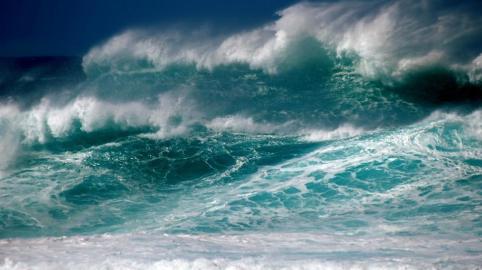
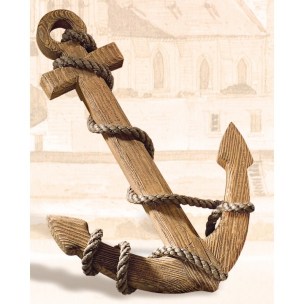 “My anchor holds within the veil,” I repeat. Since hearing the story of the ancient Mediterranean ports this line has fixed itself even more deeply in my mind. In New Testament times a huge anchor stone was sunk deep into the ground on the wharf. When ships wanted to enter the harbour a small boat, known as a forerunner, left the safety of the port, navigated its way through the hazardous waters, which the boat’s pilot knew well, and out into the open sea to the waiting ship. The pilot then took hold of the ship’s anchor rope, returned to shore and secured it to the anchor stone so that the ship could safely be brought home.
 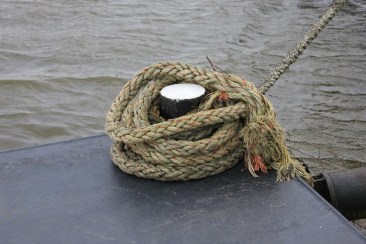 certainty. He calls me to hold fast to hope — a word which I am told, in Greek, is the same word that is used for the rope of an anchor. And just like the sailors on those ancient ships who had to abandon their oars and down sails, I too must surrender myself to the will of the forerunner and let him guide me.
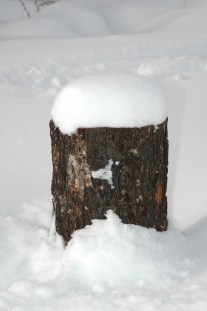
 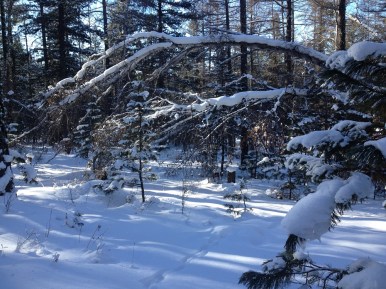 November. We’ve started taking time to sit out on a tree stump and drink our coffee. Above the trees we can see the amazing blueness of the sky, and we can hear the woodpeckers hammering on tree trunks. Small birds are returning and the tall pines are growing new needles. All around there are signs of new life, but in the midst of it all we’ve noticed that many of the silver birches are bent to the ground. Have they been weighted down with snow or damaged by the wind and ice? Or are they diseased on the inside? We don’t know but from their blackened branches and dry orange leaves they look crushed.
 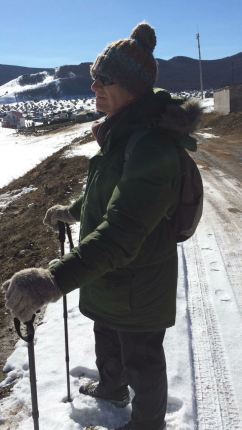 The world tells us that happiness is determined by external situations but I don’t fully believe that. When I was younger the answers to life’s problems seemed easy, more black and white, but as I get older I realise that life is more complicated. We are complex beings. The Bible tells us that man is created in the image of God. Yes! We are created in His image, fearfully and wonderfully made, people with extraordinary senses, remarkable minds that are more superior to any computer in this world and hearts that are filled with rich emotions.
 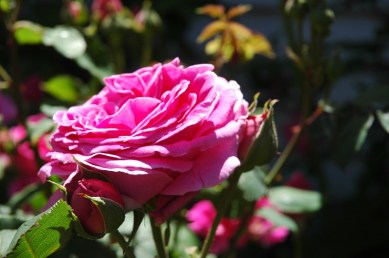 hearts of wisdom to have confidence in the complexities of life. Let’s pray that He would strengthen us in our inner beings. We are totally dependent on Him and we need a sense of Him with us. We need to be able to see Him putting His love and truth into our hearts because only God can truly fill the emptiness — He alone is the true hope of our hearts, the ultimate tree of life. Take hold of the gospel and let it work in you on the inside that we might stand upright, healthy and whole, confidence in Him.
 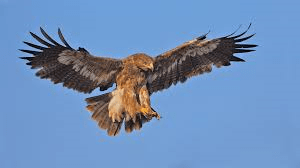 talons, possess a fierce nobility that demands respect. During the warmer months many raptors make their home on the Mongolian steppe or on its craggy peaks. Traveling in the countryside we often spot a hawk or a falcon perched on one of the white kilometre posts that mark our journey, but the sight of a small, brown steppe eagle will always cause us to put our foot on the brake.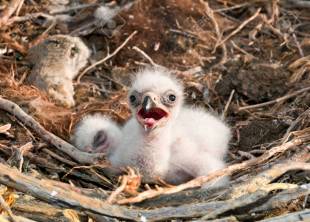
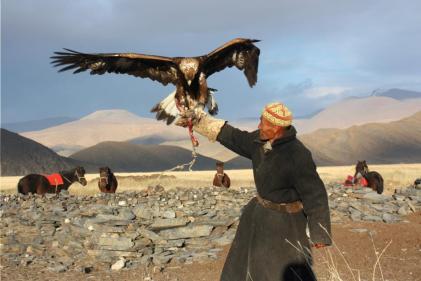 with God is so similar to that chick’s,” he says. “When I’m feeling comfortable God often comes close and begins stirring up my world until I recognise, whether I want to or not, that I must step out. Trembling, I take a shaky step and find that His presence is close, upholding me, but then He seems to distance Himself and I begin falling. I cry out and He comes, scooping me up, and letting me rest in the warmth of his closeness again. But He never lets me remain there for long. He’s always nudging me higher so that, slowly, losing my clumsy awkwardness, I learn to fly with great strength and agility and realise that I am, indeed, growing closer to God.”
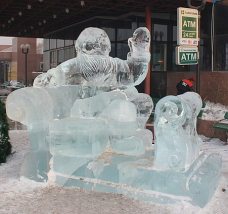 They seem to be multiplying; ice sculptures that is. This year they’re in squares, in front of shopping malls and interesting roadside locations. And I’m left wondering whether this is the latest craze.
  Satisfied he’s captured the likeness sufficiently, he fuels up his chainsaw and, pulling the throttle trigger, lets a billow of blue smoke escape as the saw spits into life. Revving the engine for a minute or more the sculptor carves away great chunks as he discards the excess. Multiple cuts later the chainsaw is silenced. The ice is no longer a neat, clean-cut block but an indistinguishable blob that leaves me scratching my head and asking, is this man
 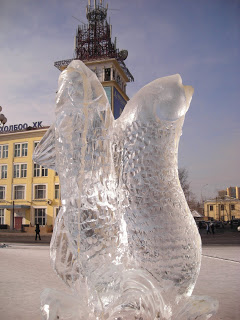 Gently tapping the steel hoop of his chisel he guides the cutting edge along the contours of the ice. He works slowly, a few taps here a few taps there, before stepping back to assess his progress. I think the image of a fish is emerging although it doesn’t look very fluid and smooth. Finally the sculptor lights a blow torch and lets the pencil tip flame glide quickly over the image, melting the imperfections and bringing a glossy polish to his work.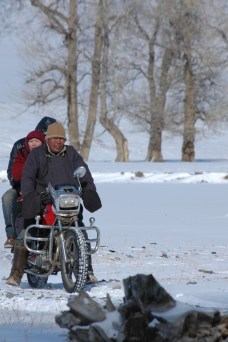
 At the weekend a glut of battered cars appears in the bus stops heading out of city. The drivers erect a row of brightly-coloured sledges and, huddled in their cars, wait for parents, driving gleaming four-wheel vehicles, to stop and buy a sledge for their children. In juxtaposition the poor and rich exist together, each struggling for a better life. It’s Christmas, I want to shout, the time when we celebrate the true, living God’s son’s birth on earth.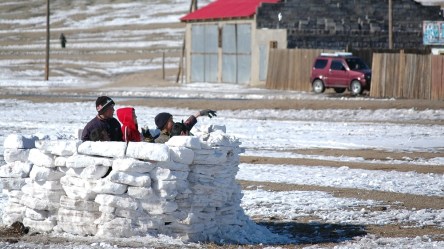
 However when my father died, nearly thirty years ago, I learned that my mother had been adopted. Such news explained so many mysteries but it also left so many questions unanswered. Who were my real grandparents, aunties and uncles? Of course there was no way to find answers to those questions but it made me realise how important it is to know that we belong.
 But the threads that bind us in families can sometimes appear as delicate and fine as a spider’s web suspended between two trees. Mostly, invisible to the eye we only see it when the shimmering sun illuminates the gossamers. Or the rain or dust weighs down the supple strands. Often, we pass by without even noticing until we find minute threads clinging to our clothes.
 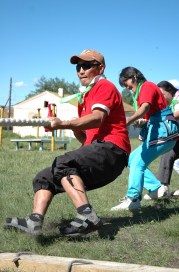 The richness of our families so often mirrors the family that God births Christians into. There are plenty of interesting characters in His family. But if we are in Christ then they all become our brothers and sisters, aunties and uncles. Many of them are easy to love and respect but there are some whose sharp personalities, actions and opinions just don’t fit with our personality and leave us never wanting to speak to them again. Yet as Christians, for better or worse, we are in God’s family, we are a brother or sister, an older or younger member. And God calls us to love those in His family, even the strange one with all their faults and idiosyncrasies, and in loving them we soon learn that we too have plenty of faults and idiosyncrasies ourselves.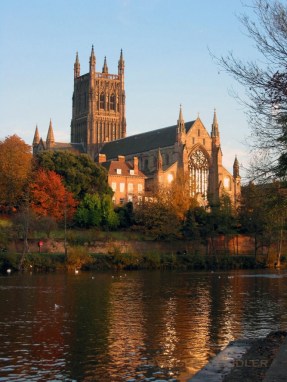
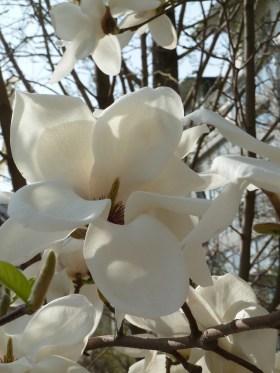 Bemoaning this loss, I told God I didn’t think it was fair. (You’d have thought I’d have learned by now that life isn’t always fair.) Nevertheless, in my gloom God extended His grace as the faces of friends, unbidden, started coming to my mind. A long-term gossip, who now speaks words of encouragement, has become an inspiration to many. Another, rescued from dark years of alcoholism, is helping others find freedom.
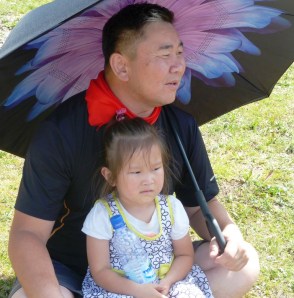 Although the warm days speed by the Mongolians take time to revel in each and every one. Those who spent their summers near us let the days meander at their own pace, eating what they have, sleeping when they’re tired and enjoying time with family and friends without too much thought for tomorrow.
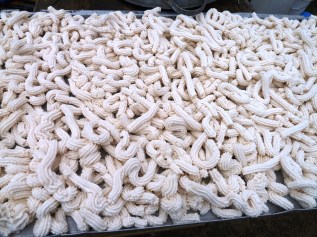 Storing food for tomorrow seems sensible but I wonder what motivated the Israelites. Did they doubt God’s promises? Or imagine a day would come when He would not be present or not supply the nourishment they needed?

