
‘We all live busy lives,’ said Baatar as he preached on Sunday. We agreed, thinking of time spent sitting on Ulaanbaatar’s vehicle-choked roads, trying to find a precious parking space before the two of us head off in different directions to days filled with meetings, tricky discussions and lessons. We love what we do, but by the time we’ve crammed as much as we can into one day, we feel frazzled.
It’s not the first time we noted the swift pace at which city life moves and pondered Baatar’s question, ‘How do we find balance and peace in God in the midst of the rush?’
Last Saturday we drove over the pass to walk some of our favourite ridges. The valley used to be home to a few herders and their animals; now new fences cover the hillsides as people claim the best spot for their summer holiday homes. Thankfully, the herders are still there and there’s one we’ve got to know.
Originally from the city, Baasan-huu lives in a ger with his wife and family at the bottom of the hill close to the road. First time we chatted with him, he was lying leisurely beside his horse, reins secured around his boot, so his horse could not wander off. Handing us his ancient Nokia phone, he asked us to help him use it. Not that he needed the phone as his loud instructions to his granddaughter echoed through the whole valley.
On Saturday we talked with Baasan-huu about war, life, church and politics. In his long red deel and thick felt boots, he is a quiet, knowledgeable man. Through his large round glasses, perched on the end of his nose, he eyes us sagely.

We said our goodbyes, observing him too as he picked up the reins to lead his horse and flock over the hill and up the next valley. The sun dropped, silhouetting man and horse against the pale sky as they climbed the rocky slope. There was an ease in his gait, a nimble steadiness that denies his seventy or more years. He is at home in this place, he knows it well.
Part of me envies the simplicity of his life, firmly embedded in family and locale. The land is important to Mongolians, especially countryside folk, who feel like they are a part of it. I have no such connection, although I do know the one who created this place. It is His and reflects His nature.
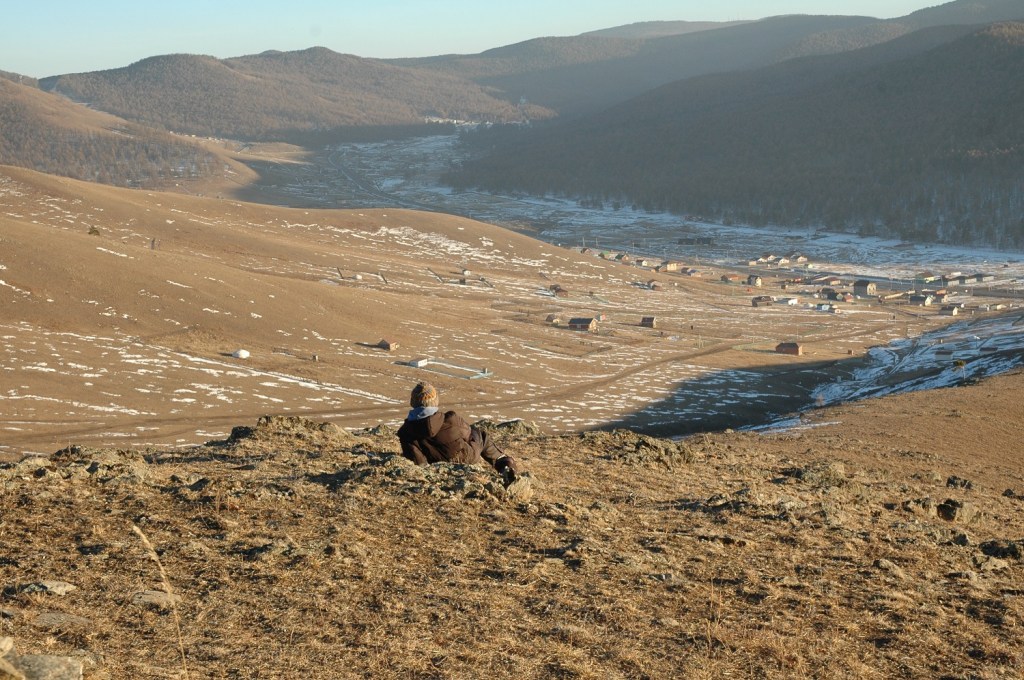
Baasan-huu’s life is one of stable discipline: work, food and rest. Not that he lacks challenges, but the unhurried nature of it resonates with rhythm. This rhythm causes me to recall the rhythms of godliness I seek to cultivate in my life: prayer, deeper understanding of God and His word, ministry and rest.
Like Baasan-huu, I must discipline my life. To find balance amid life’s constant activities, I habitually need to learn to quiet my heart and mind and be open to God’s grace. Embracing and receiving His grace brings stability to my scattered, tired thoughts. This stability roots me in God, enables me to navigate the ever-changing flow and recognise that God is in the city rush and the hushed wooded forest too. He is everywhere.
© copyright Gillian Newham 2022
 Nomadic Pages