White-capped waves furiously beat the craggy cliffs of the North Cornish coast. Churning grimly, the sea seizes fishing vessels, sending them pitching and plunging like corks bobbing in a barrel full of water. The wind, a demented soul, howls and thrashes, petrifies trees, setting them in an angled quiff. My lips are thick with salt as the sky darkens, bringing with it a veil of rain that obscures sun and moon.
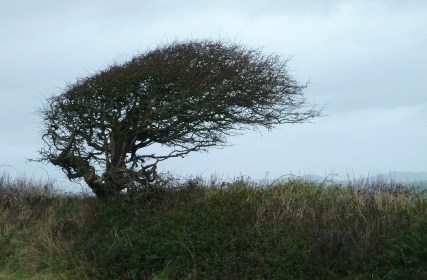 This is a wild place of untamed ocean and largely uninhabited coastline, of secluded beaches and hidden inlets. Standing on the cliff’s edge looking out to sea, it’s easy to imagine smugglers dragging ashore cases of tea and brandy, rum and tobacco.
The sea is the block and tackle of this county. Fishermen still fish these waters and all its residents draw enjoyment from its coast. Whether the Atlantic gives people a living, or some form of recreation, all know these waters are an unpredictable master that no man can quell.
People say some sailors still hold to the ancient rituals, believing that good or bad omens influence their voyages. Even in this day of global positioning systems, gyrocompasses and radar, sailors still scan the horizon for the single light that pierces the darkness.
Standing on the dramatic edge of land and sea, lighthouses emit concentrated beams that once guided mariners to a harbour’s safe entrance or warned of hazardous reef formations below the water and dangerous rocks close by. Their light, pulsating across the darkness, says “Beware! Danger!” Or “come this way!”
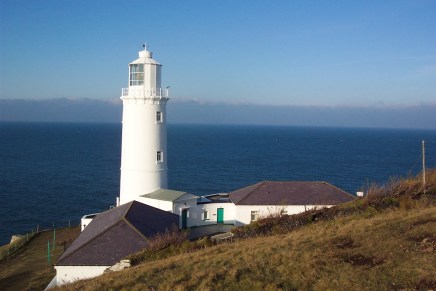 Lighthouses have a long history, the oldest dating from the 3rd century BC. In Britain, the lighthouse was initially a fire lit on the ground. Later that fire was placed on a platform before engineers began the challenging job of designing a tower, like the trunk of an oak constructed from granite, to house the rotating light. Each lighthouse, or series of lighthouses, had a slightly different pattern of signals that allowed the mariner to identify their location.
Short or tall, painted white, or even striped lighthouses are still clearly visible from land or sea. In the nineteenth and twentieth centuries, lighthouses were manned by a keeper. Some romantics envied the life of a keeper but the reality was somewhat different. Keepers in isolated locations found the long periods of confinement drove them close to madness. Yet the lighthouse and its keeper provided safe guidance and comfort to seafarers.
Today Britain’s lighthouses are all fully automated and monitored from remote offices around the country. Some lighthouses have even been decommissioned. They are no 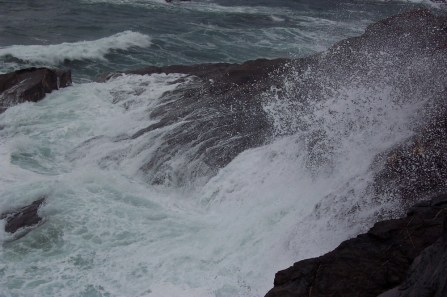 longer needed by the seafarer. The keepers have all gone, their homes derelict or turned into fashionable holiday residences. And yet from our Cornish window, the light of Trevose Head, some twenty miles down the coast, can still be seen. Its light is still a beacon solid and stable, offering comfort and continuity, strength and stability to today’s sailors. No matter what the weather, its light is unchanging.
That simple light reminds me of Christmas, and the true reason we celebrate. Jesus Christ, the light of the world, came into our darkness. Despite the changing times, He is still the light that shines, guiding us to the right path and warning us of the dangers in life. He is the true comforter and giver of strength. The one who gives inspiration to the weary soul in the stormy seas of life.
 Nomadic Pages